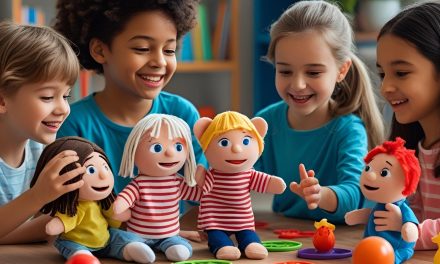
Nobody teaches a four-year-old how to negotiate whose turn it is to fly the cardboard spaceship. Yet somehow, they figure it out.
One minute they’re arguing over who gets to be captain. Five minutes later they’ve settled the dispute, assigned everyone a role, and launched an imaginary mission to Mars. Adults call it “playing.” Child development experts call it one of the richest communication classrooms a child will ever have.
Pretend play gives children something worksheets never can: a reason to talk, listen, explain, persuade, negotiate, and solve problems in real time. Every made-up restaurant, doctor’s office, classroom, or grocery store becomes a safe place to practice conversations they’ll eventually have in the real world.
In this guide, we’ll explore how imaginative play strengthens communication skills through everyday role-play activities, active listening, and meaningful conversations that prepare children for life far beyond the playroom.
Communication Skills Begin with Make-Believe
Children don’t become confident communicators by memorizing bigger words. They become confident by using language with purpose.
Pretend play creates countless opportunities for children to express ideas, explain decisions, ask questions, and respond to others naturally. Instead of answering questions because an adult asked them to, they’re communicating because the game depends on it.
A child pretending to run a café quickly learns that taking an order requires listening carefully. A pretend veterinarian must reassure worried pet owners. A teacher explains instructions to students. A firefighter gives directions during an imaginary rescue.
Without realizing it, children begin adapting how they speak depending on who they’re pretending to be.
Researchers have long associated imaginative play with stronger language development, richer vocabulary, and improved social communication because it encourages children to think before they speak while responding to changing situations.
The more varied the pretend scenarios become, the more flexible children’s communication skills grow.
Everyday Conversations Become Learning Opportunities
Role-playing offers children something many structured learning activities cannot—real conversations with a purpose.
Rather than asking random questions, children begin following the natural rhythm of dialogue. They greet someone, ask questions, listen to answers, and respond appropriately.
A simple pretend doctor’s office demonstrates this perfectly.
One child answers the toy phone.
“Good morning. Dr. Sarah speaking. How can I help you today?”
The patient explains what’s wrong.
“My stomach hurts whenever I eat ice cream.”
The doctor asks follow-up questions before suggesting treatment.
The exchange feels like play, but it teaches children how conversations build step by step. They discover that asking thoughtful questions often matters just as much as giving answers.
Toy phones, shop counters, restaurants, schools, and cafés all create opportunities for these kinds of natural conversations. Every interaction strengthens confidence while expanding vocabulary without children feeling like they’re in a lesson.
Listening Is Half the Conversation
Confident communicators aren’t simply good talkers—they’re good listeners.
Pretend play naturally develops active listening because every storyline depends on paying attention.
Imagine one child pretending to visit a clinic.
“My ear hurts, and I feel dizzy when I run.”
Instead of immediately prescribing medicine, the pretend doctor first repeats the information.
“So your ear hurts, and running makes you feel dizzy?”
That simple habit teaches one of the most valuable communication skills children can develop: confirming they’ve understood someone correctly before responding.
Role reversals make this even more effective.
A child who spends five minutes pretending to be the doctor suddenly becomes the patient during the next round. Experiencing both perspectives helps children understand that good communication involves speaking clearly and helping others feel heard.
Parents can build on this by introducing short storytelling games where one child listens before retelling the story in their own words. Activities like these improve attention, memory, and conversational confidence while making listening feel just as enjoyable as talking.
Conclusion
Pretend play may look like simple fun on the surface, but every imaginary conversation helps children prepare for real ones. Whether they’re taking a patient’s symptoms, serving customers at a pretend café, or settling a disagreement between superheroes, they’re learning how to express themselves, listen carefully, ask thoughtful questions, and respond with empathy.
The beauty of these lessons is that they happen naturally. There are no scripts to memorize or tests to pass—just meaningful interactions that help children become more confident communicators one game at a time.
Communication is just one of the many life skills children develop through imaginative play. Keep exploring Marvelus Kids to learn other skills that pretend play can instil in your little ones.