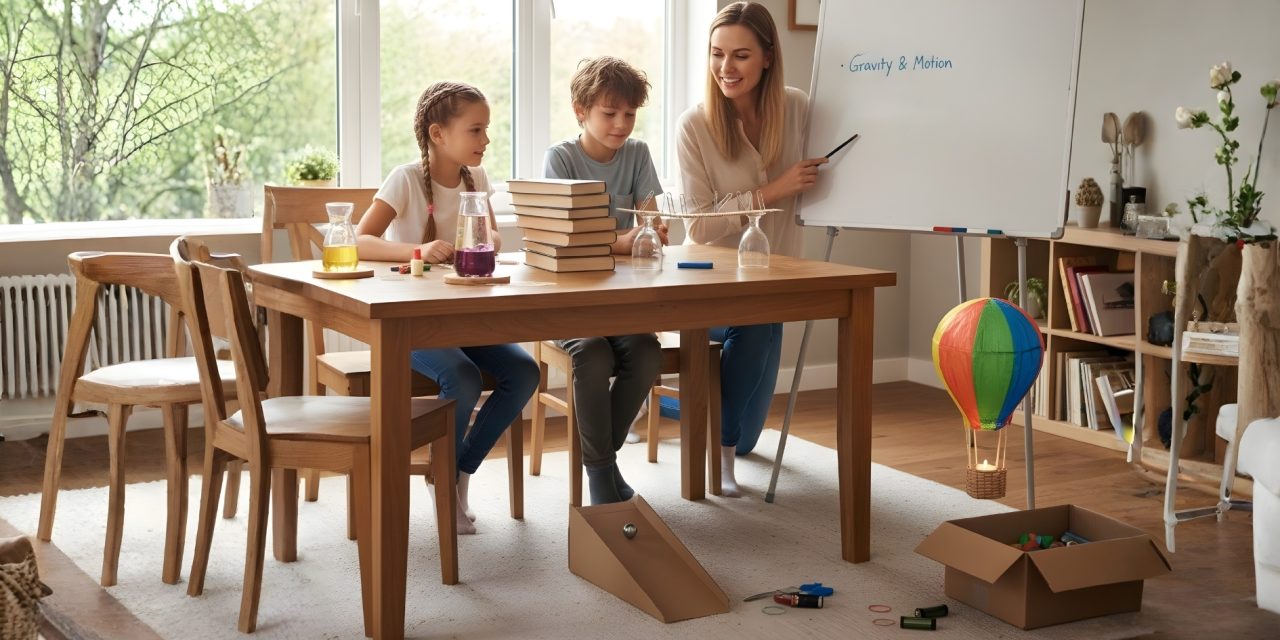
Physics often feels intimidating to kids because it’s introduced as formulas instead of experiences. Words like force and motion sound abstract until something rolls, tips, or suddenly moves faster than expected. At home, everyday objects quietly solve that problem by turning invisible concepts into things kids can see and feel.
When children experiment with items they already recognize, learning becomes familiar rather than forced. A ruler, a coin, or a stack of books becomes proof that science isn’t locked inside classrooms. It’s already part of daily life—waiting to be explored.
Simple Machines Kids Can Actually Understand
Simple machines aren’t complicated when kids build them themselves. A ruler balanced on a pencil becomes a lever. A string over a door transforms into a pulley. Stack books into a ramp and gravity immediately shows its personality.
The real learning happens before anything moves. Asking kids to predict what will happen creates curiosity and ownership. Will the marble roll faster on a steeper ramp? Will lifting a book feel easier with a pulley? Those guesses turn play into problem-solving.
Each setup takes minutes and uses common items. Precision isn’t the goal—observation is. Kids learn that balance points matter, angles change speed, and small adjustments can completely change outcomes.
Why Motion Makes Learning Stick
Children remember what they discover themselves. When a CD rolls farther because friction is reduced, or a doorstop lifts weight with less effort, the lesson becomes physical. Motion replaces memorization.
Tracking predictions versus results builds early scientific thinking. Kids learn that being wrong isn’t failure, it’s feedback. Over time, this strengthens confidence, patience, and reasoning skills that extend far beyond science.
Parents often notice improved focus too. Hands-on experiments naturally slow kids down and hold attention without screens or pressure.
Learning That Fits Real Homes and Real Schedules
These physics activities work because they respect real life. They’re quick, low-mess, and flexible enough for kitchens, living rooms, or small apartments. There’s no need to “teach” formally, curiosity does the work.
As hands-on learning becomes more important, simple experiments remain one of the most effective ways to nurture curiosity early. They turn ordinary moments into shared discoveries, strengthening both understanding and connection.
Conclusion
Physics doesn’t need expensive kits or complex explanations to make sense. When kids explore motion and simple machines using familiar objects, learning feels natural and empowering rather than overwhelming.
These small experiments build more than STEM skills. They encourage questions, patience, and confidence—tools kids carry into every subject. By making physics part of everyday play, families create a foundation for learning that lasts far beyond childhood.
If your child already tests how the world works through play, how often do you pause to explore those moments together? Marvelus Kids helps families turn everyday curiosity into meaningful learning experiences.