Ever notice how the word “STEM” can make things feel… intense? Flashcards. Worksheets. Structured programs. Deep breath.
Here’s the truth: engineering skills grow faster on the living room floor than at a desk.
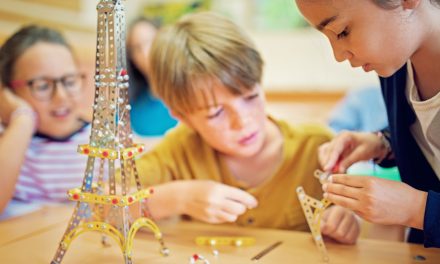
According to NAEYC engineering standards, hands-on building strengthens real problem-solving more effectively than paper exercises. Research out of MIT has also linked block play to stronger math performance and spatial reasoning — a foundational skill for future STEM success.
The best part? It doesn’t have to feel like school.
When kids stack, balance, test, and rebuild, they’re naturally engaging in the iterative design process — experiment, tweak, try again. No pressure. No perfect outcome required. Just discovery.
Welcome to STEM without stress.
Why Building Beats Worksheets
Engineering isn’t about getting it right the first time. It’s about:
- Testing ideas
- Learning from mistakes
- Adjusting designs
- Trying again
When kids build with blocks, cardboard, or modular systems like LEGO Duplo, they’re developing:
- Spatial reasoning
- Critical thinking
- Resilience
- Creative problem-solving
And they don’t even realize they’re “doing STEM.”
This kind of playful science builds cognitive skills at a pace that feels natural — not pressured. Add role-play (“You’re the lead engineer!”) or mix in art for STEAM expansion, and suddenly engineering becomes storytelling, creativity, and imagination combined.
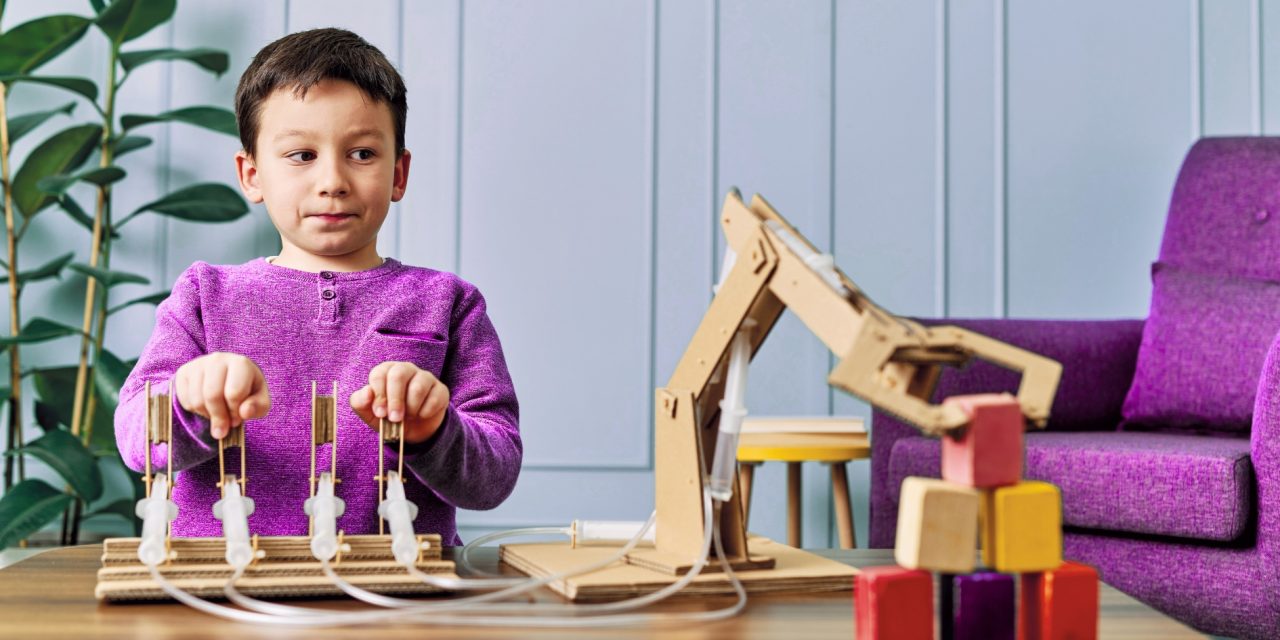
Cardboard Construction Projects (Big Thinking, Zero Fancy Supplies)
You don’t need expensive kits to teach engineering concepts. A few boxes and tape can turn into a 3-foot-tall crane that lifts two pounds — and delivers a full lesson in structure and physics.
45-Minute Cardboard Crane Blueprint
- Sketch the design (identify load, boom, base)
- Cut reinforcement triangles for stability
- Assemble a simple pulley using strong string or fishing line
- Add a counterweight to explore balance
- Gradually test with increasing weight
Kids naturally encounter terms like tension, compression, fulcrum, counterweight, stability — not because they memorized them, but because they experienced them.
Extensions?
- Build bridges
- Design towers
- Create marble runs
- Test structural limits
This is maker learning at its most accessible.
Simple Block Machines (Physics in Motion)
With just 20 blocks, kids can build a 6-step marble run that teaches gravity, friction, and momentum. Using LEGO Duplo or sturdy wooden blocks, try this configuration:
- Ramp: 3 stacked blocks for acceleration
- Funnel: 5-block pyramid to narrow the path
- Zigzag: 4-block S-curve for directional changes
- Loop: 8-block circle for continuous motion
Then ask:
- “How could we slow the marble down?”
- “What would make it go faster?”
- “What happens if we raise the ramp?”
This transforms play into controlled experimentation — without worksheets, timers, or pressure. Ages 3–7 can explore basic setups. Older kids can increase complexity, adjust angles, and experiment with variables.
That’s real engineering thinking.
Conclusion
STEM doesn’t begin with memorizing formulas. It begins with stacking, balancing, testing, and rebuilding.
When children work with building and engineering toys, they aren’t just passing time — they’re developing spatial reasoning, critical thinking, and resilience. They’re learning that ideas can be tested, improved, and reimagined. That’s the foundation of engineering.
What if engineering time felt like playtime instead of pressure? Discover hands-on STEM ideas and stress-free building inspiration at Marvelus Kids!