You don’t need goggles, lab coats, or a PhD to raise a curious kid—just a kitchen, a few everyday ingredients, and a willingness to let things fizz a little. In homes where curiosity is encouraged, the kitchen often becomes the first science lab, long before textbooks or formal lessons enter the picture. That’s where everyday household experiments shine, turning ordinary moments into hands-on STEM learning without pressure or price tags.
These simple activities meet kids exactly where they learn best: through movement, observation, and trial-and-error. Instead of memorizing concepts, children see reactions, feel textures, and predict outcomes in real time. This article explores how accessible kitchen chemistry and water-based experiments can spark critical thinking, strengthen problem-solving skills, and make STEM feel less like school—and a lot more like play.
Kitchen Chemistry: Simple Experiments with Big STEM Payoff
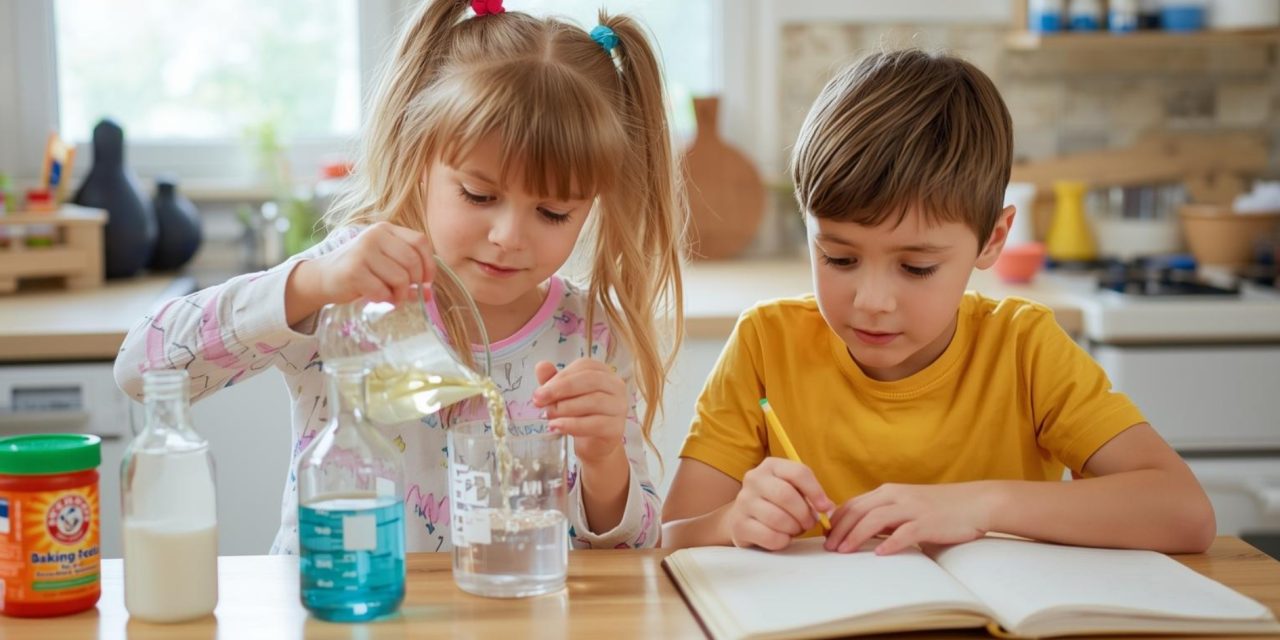
Kitchen chemistry works because it delivers fast results with familiar materials. Baking soda, vinegar, milk, and cornstarch create visible reactions that help kids understand abstract science concepts without pressure. These experiments support kinesthetic learning, allowing children to touch, pour, and observe while building early chemistry and problem-solving skills.
A baking soda and vinegar reaction, mixed at a simple 1:3 ratio, introduces acid-base reactions in under five minutes. Adding dish soap turns it into a foamy volcano, making gas production impossible to ignore. Milk and food coloring experiments demonstrate surface tension, while cornstarch oobleck introduces states of matter in a way kids can literally feel.
Lemon batteries push learning slightly further by showing how chemical reactions can generate electricity. Using zinc nails and copper pennies to power a small LED helps kids connect chemistry with real-world energy concepts. Encourage predictions before each experiment to build inquiry-based thinking and confidence.
Water Density Challenges That Turn Physics into Play
Water-based experiments are especially effective for visual learners. Creating a density tower using honey, dish soap, water, oil, and rubbing alcohol allows kids to see physics concepts in action. Each layer stays separated, showing how density determines whether liquids sink or float.
Pouring each liquid slowly—sometimes over the back of a spoon—adds a fine-motor challenge while reinforcing patience and teamwork. Kids quickly grasp that heavier liquids settle at the bottom, even without memorizing definitions. Variations like saltwater density or hot-and-cold water convection extend the learning without changing the setup.
These activities naturally support collaboration. One child pours while another observes or records predictions, turning science into a shared experience rather than a solo task. Cleanup is quick, which makes these experiments practical for regular STEM play at home.
Conclusion
Everyday household experiments prove that STEM learning doesn’t need expensive kits or complicated instructions. With common materials and a bit of curiosity, kids explore chemistry and physics in ways that feel accessible, engaging, and fun. When learning happens through play, understanding sticks—and confidence grows right alongside it.
When was the last time your kitchen doubled as a science lab your kids couldn’t stop talking about? Marvelus Kids shares simple, hands-on STEM ideas that turn everyday moments into learning experiences kids actually enjoy.