Remember those days when “science” meant staring at a textbook and hoping the teacher didn’t call your name? Thankfully, times have changed. Today, science kits make learning fun, interactive, and even a little magical.
Whether it’s chemistry fizzing, circuits sparking, or butterflies hatching, these kits transform curiosity into hands-on discovery. Let’s take a look at some of the most exciting types of science kits available and why they continue to spark imaginations.
Chemistry Kits
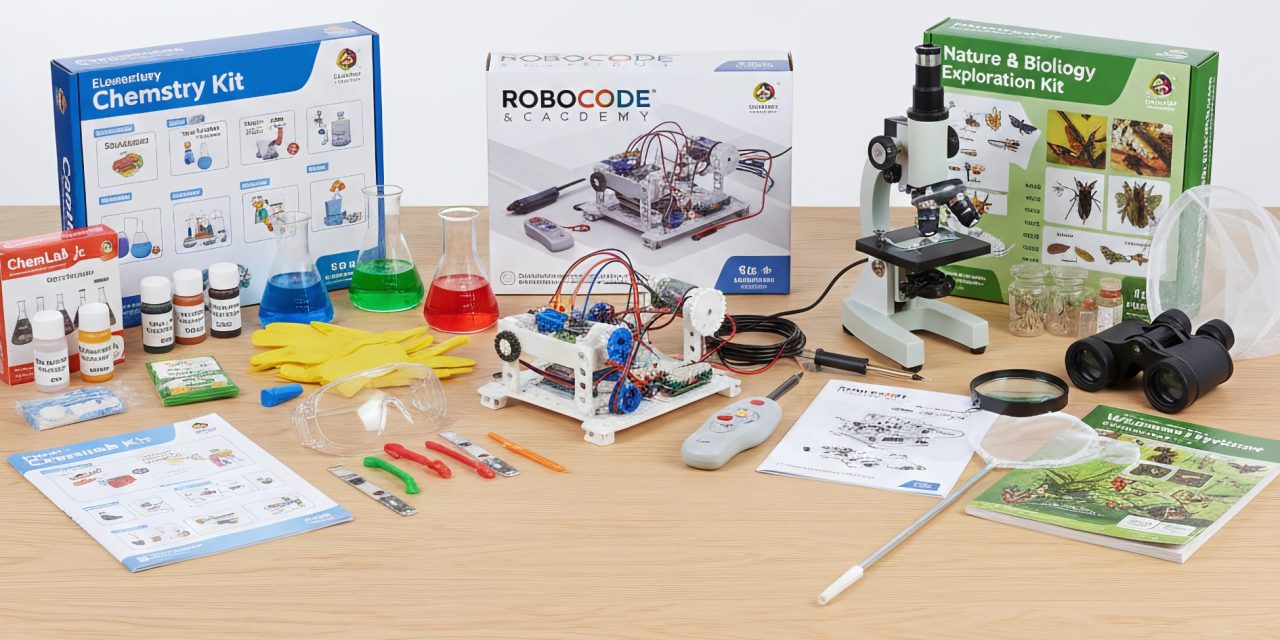
Chemistry kits bring experiments to life in ways a worksheet never could. Take the Thames & Kosmos Chem C1000, for example. It gives kids the chance to explore pH levels, acids, and bases in a safe environment. With step-by-step guides, children can create colorful chromatography or test reactions without the risk of blowing up the kitchen.
Most kits also include goggles, gloves, and clear safety instructions, giving young learners the confidence to experiment freely. Beyond the bubbling fun, chemistry kits help kids understand scientific methods, build critical thinking, and develop lasting curiosity. It’s hands-on learning that feels more like play than study.
Physics Kits
If chemistry teaches reactions, physics kits explain the “why” behind the world’s mechanics. Kits like Snap Circuits or LittleBits encourage children to build functioning circuits, light up bulbs, and create working devices. Instead of abstract diagrams, kids see real results the moment they connect the pieces.
The Thames & Kosmos Electricity and Magnetism Kit goes further, allowing experiments with magnets, currents, and even electromagnetism. These experiences not only sharpen problem-solving skills but also promote persistence through trial and error. By the end, kids don’t just memorize physics—they experience it firsthand.
Biology Kits
Biology kits focus on life itself. The Ecosystem in a Bottle kit, for instance, lets kids create a mini-world and observe how plants, water, and organisms interact. The Life Cycle of Butterflies kit takes it a step further by showing metamorphosis unfold in real time.
These kits often combine living specimens with tools for observation, such as magnifying glasses or small microscopes. By seeing the natural world up close, children learn that science isn’t distant or abstract. It’s alive and connected to their everyday lives. They begin to understand ecosystems and life cycles in ways no chart could ever explain.
Conclusion
Science kits prove that learning doesn’t have to be dull or intimidating. They merge discovery with play, teaching everything from reactions to ecosystems in ways that stick. By offering hands-on experiences, they spark a lifelong interest in science and give kids the tools to think like real scientists.
But here’s the real question: could today’s fun experiments inspire the inventors and innovators of tomorrow? Dive deeper into learning tools and ideas at Marvelus Kids—you might discover the next kit that ignites curiosity in your own home.