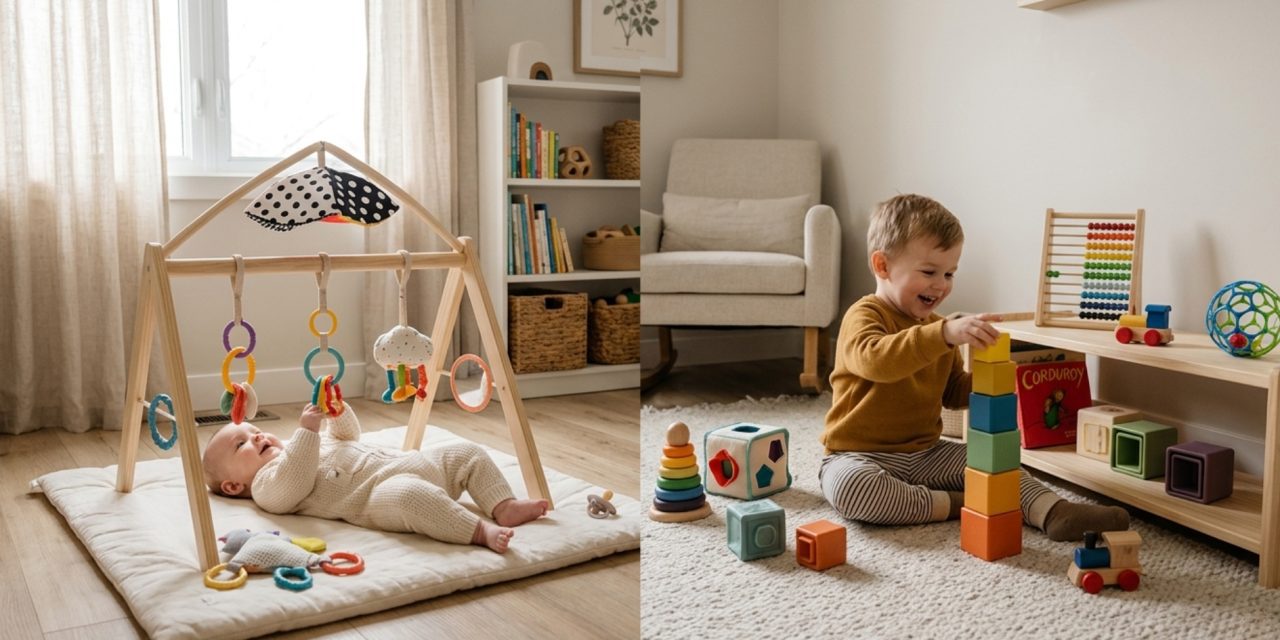
The first three years feel like fast-forward—one minute it’s tummy time, the next it’s tiny footsteps across the room. With so much change packed into such a short window, buying toys that only work for one stage quickly becomes expensive (and cluttered).
That’s where “grow-with-me” toys earn their keep. Instead of replacing items every few months, the right picks evolve alongside your child—shifting from sensory play to problem-solving, from passive watching to active exploration.
Infancy to Toddler Stage (0–3 Years)
By age three, a child’s brain reaches roughly 90% of its adult size, which explains the constant leap in skills. Early months focus on sensory input—contrast, sound, touch—while later stages demand interaction, movement, and curiosity-driven play.
The smartest toys in this phase don’t stay static. They adapt. A simple object might start as something to look at, then become something to grab, stack, sort, and eventually imagine with. That progression is where real value sits—not just financially, but developmentally.
Materials matter too. Durable wood and BPA-free plastics tend to outlast rough handling, while also keeping safety in check. Combine that with a simple toy rotation system, and suddenly even a small collection feels fresh, engaging, and purposeful.
Multi-Functional Activity Centers
A well-designed activity center is one of the clearest examples of a toy that evolves with your child instead of being outgrown in weeks.
Take the Lovevery The Play Gym. It begins as a calm, sensory-rich space for newborns, using high-contrast visuals to support early visual tracking. At this stage, the baby is mostly observing—but even that is building neural connections.
As months pass, the same setup invites reaching, kicking, and grabbing. Mirrors, textures, and hanging elements shift the experience from passive to interactive. By the toddler stage, parts of the gym transform into independent play tools, encouraging cause-and-effect thinking and exploration.
Instead of buying three separate products, one adaptable system carries the child through multiple milestones. That continuity also helps with familiarity—kids engage longer with something that “grows” with them.
Stacking and Nesting Sets
Few toys look simpler than stacking blocks, yet they quietly support some of the most important developmental shifts.
The Melissa & Doug Soft Activity Nesting Blocks are a great example of this layered progression. Early on, they’re all about touch—soft textures, safe mouthing, and basic grip development. At this stage, even holding a block is a win.
As coordination improves, stacking begins. Then comes nesting—understanding size relationships, spatial awareness, and sequence. By around age three, those same blocks turn into storytelling tools, becoming towers, houses, or anything imagination allows.
That journey—from sensory exploration to creative play—makes these sets incredibly efficient. Instead of replacing toys as skills grow, the use of the toy evolves naturally.
Wrap Up
Toys that grow with your child do more than save money—they create a smoother, more intentional play experience. Instead of constantly introducing something new, they deepen engagement with what’s already there.
From adaptable activity centers to simple stacking sets, the goal is the same: support development at every stage without overwhelming your space. When chosen well, a single toy can carry months—or even years—of meaningful play.
Are you choosing toys for the moment—or for the next stage your child is about to step into?
Let us know in the comments, and keep discovering smart, long-lasting play ideas only at Marvelus Kids!