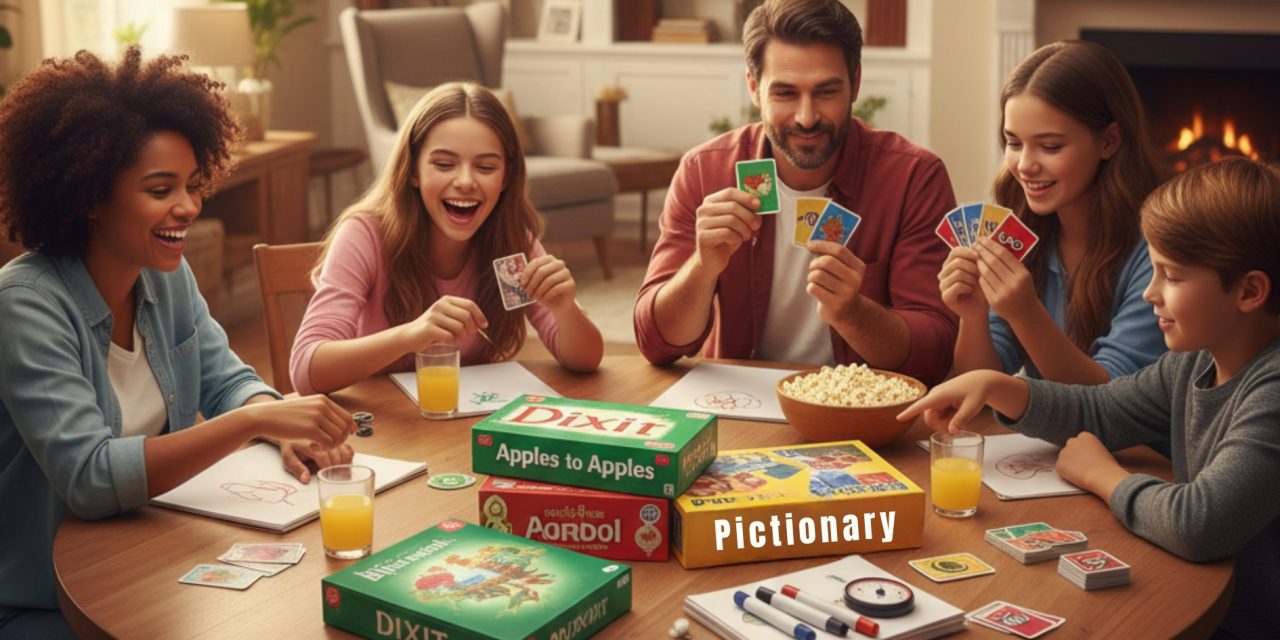
If Part 1 proved that strategy, wordplay, and resource bargaining can turn any living room into a competitive arena, Part 2 shows what happens when creativity, chaos, and pure silliness join the table.
Families who enjoyed plotting train routes, decoding clues, or negotiating for brick will find a new kind of fun here—stories that spiral, drawings that confuse everyone, and card plays that test both luck and patience. These next four games pick up right where the first three left off, keeping game night lively, imaginative, and packed with the kind of moments everyone remembers long after the scorecards disappear.
4. Dixit
Why It Works for Game Night
Dixit turns storytelling into a colorful guessing game powered by beautifully illustrated cards. Players describe one card with a clever clue, while others try to guess which picture inspired it. The real challenge is crafting clues that are clear enough to guide your team but mysterious enough to avoid helping everyone else. A custom scoring system—like giving 1 point for clarity, 2 for cleverness, and 3 for unexpected connections—keeps imagination at the center of every round. New players can level up quickly with a short tutorial such as “Mastering Card Clue Challenges,” helping them understand how creativity drives the entire experience.
Family Fun Factor
Families love how Dixit gets kids talking, imagining, and turning simple images into memorable stories. A picture of a tree might become a tale about hidden treasure or a touching memory of a family hike. These stories often spark deeper conversations, helping everyone share personal experiences in a relaxed way. The game feels gentle, expressive, and surprisingly emotional—perfect for families who want a mix of creativity and connection in every round.
5. Apples to Apples
Why It Works for Game Night
Apples to Apples transforms word matching into a laughter-filled showdown. Players place their funniest or most fitting card to match the judge’s prompt, creating wild combinations that make every round unpredictable. To help younger kids join in, simplify complex prompts or swap them for themes like animals or food. House rules—such as bonus points for outrageous choices—keep the game’s pace fast and the humor steady. This flexibility makes the game easy to learn and even easier to enjoy with mixed-age families.
Family Fun Factor
The joy comes from the unexpected matches. A single prompt can spark debates, inside jokes, and dramatic reenactments that no one asked for but everyone loves. Families often share how their kids become comedic masterminds just by choosing the most absurd card in the pile. Because the game doesn’t rely on strategy, it gives everyone a level playing field—and the laughter lasts long after the round ends.
6. Pictionary
Why It Works for Game Night
Pictionary turns drawing into a high-energy guessing race. One player sketches a word or phrase while the rest scramble to figure it out before the timer stops. Digital versions like Skribbl.io make game night simple for larger groups, while Pictionary Air brings a fun twist by letting players draw in the air using their phones. Choosing categories—movies, animals, or famous landmarks—keeps the creativity flowing and helps younger players stay engaged.
Family Fun Factor
Even the worst drawings get the biggest laughs, especially when someone’s “dog” looks suspiciously like a potato with anxiety. Families love the chaotic guessing, the frantic lines on the screen, and the shared suspense of the ticking timer. The game inspires teamwork, communication, and hilarious moments nobody can recreate—even if they try.
7. Uno
Why It Works for Game Night
Uno blends strategy and luck in a way that excites both kids and adults. Players match cards by color or number while using powerful action cards to shift the momentum. The Skip card creates drama. The Reverse card sparks chaos. Encouraging kids to explain their moves helps them practice decision-making and keeps everyone engaged. Adding a quick timer for each turn keeps the pace lively, especially with larger groups.
Family Fun Factor
Families enjoy Uno because it’s simple, fast, and full of moments where someone’s entire plan collapses thanks to one perfectly timed Draw Four. Kids love the thrill of shouting “UNO!” at full volume—usually too early. Parents appreciate how the game stays light but still prompts strategic thinking. Every round feels different, and every victory feels worth celebrating.
Conclusion
From whimsical storytelling to frantic sketching and dramatic card plays, these games bring families closer through creativity, chaos, and shared laughter. Dixit inspires imagination, Apples to Apples sparks pure hilarity, Pictionary unleashes artistic surprises, and Uno delivers quick strategy with just enough mischief. Together, they turn ordinary evenings into meaningful moments that feel like traditions in the making.
Which of these four games will your family reach for next? Discover more game night favorites and find new ways to bring everyone together at Marvelus Kids, where fun and connection always take center stage.